Tuesday, 19 September 2017

Thoughts on best achievements

Back between 2003 and 2007 I studied physics at university. Last week I had a phone call from someone writing on vision impaired people and physics. You are probably thinking, what has this all to do with shooting? Within the conversation with the journalist he mentioned that he had done a web search and seen that I also do shooting and he asked the question of what would I describe as my best achievement in shooting. This question has come up before when talking with people about VI shooting, so may be it is time to also answer it here on this blog.

I am going to pick three which have particular significance to me, although there are others which also mean something to me.

  1. Back around the late 1990s and early 2000s the British always had a team go over to the Dutch Open Championships. In 2000 it was my first time in being selected to go with the team and first time I had shot in a competition in another country. It was the biggest thing I had done in shooting at that point and I definitely had nerves. Dispite feeling that pressure, I won the supported competition (standing, shooting from a support rest). Since then I have done things which are a greater achievement, but this probably is where I really started getting that competitive thing in shooting and the hunger to push further.
  2. Next we jump forward to 2014 and the IPC Shooting VI demonstration event in Suhl in Germany. Whilst the number of shooters participating were only a few, we had all been selected as top VI shooters for the demonstration event, so I was competing against the best. Also we were using unfamiliar equipment as IPC Shooting wanted to run it with the equipment they wanted for the future. The equipment was the EcoAims Biathlon equipment, fortunately things have been tweaked since there to make it better for target shooting and also the plan is to still use actual air rifles. I think the first time I had ever used the system was in the practice the day before competition. So I was really pleased to win that competition and the trophy is one I really value.
  3. Finally but not least is the first medal I won in the Cambridgeshire postal league competition here in the UK. Why does a UK postal league competition, it was not even the first division, have more significance to me than some of the international achievements and medals? Well this competition is a standard shooting competition against sighted shooters and also using the smaller air rifle target. So due to the number of shooters who take part and also because of the smaller target, I had absolutely no room for silly mistakes and to be able to successfully compete against sighted shooters helped me gain an idea where my shooting is against more than just the VI shooting community.

Sunday, 7 May 2017

Progress with air pistol

Back at the start of March once the British championships were over I took the decision to take a break from the air rifle and really give some time over to the air pistol. Over the winter I had been getting the feeling that postal competitions had slightly taken over my air rifle shooting and were determining what I was prepared to do in my training. The main problem being that I was focusing on keeping the score best for the immediate rather than being able to try out things which might work out better in the long term but with a short term negative impact on score. As I have not done much more than prove the concept with the air pistol until the start of March, I felt focusing on the air pistol would be a good break as I would have no expectations of what I should be able to do and so would not be constantly comparing what I achieve against expectations.

Back at the start of March I was probably getting scores around 90 average for 10 shots, may be low 90s on a good day. Then about a couple of weeks ago something seemed to click with me.

Yes that is a 578 with 60 shots and this week was also similar at 575.

So what had clicked? After all I have not adjusted much since originally trying the air pistol. I cannot be certain, but one thing is that I have become very aware of sensing the position, it is very different to sensing the position with the air rifle. With the air rifle if something is not quite in the right place then another contact point probably will not line up and so you know very quickly something is not right, but with the air pistol there are so few contact points that you really need to feel it internally. Also to help with the position I have placed an elastic band around the support bar of the support stand to provide me with a reference point when checking the placement of the pistol on the stand after loading.

The other thing to come out of spending so much time with the air pistol is that may be I am starting to get more familiar with the VIASS. Back with the rifle I found myself continually comparing it with the Swarovski, both in the sound it makes and also in the scores I achieved and due to needing to shoot postal competitions I would keep changing it back to the Swarovski so that my competition cards would be as good as possible. With the pistol I don't have the choice, the Swarovski won't fit and until the start of March I had no previous pistol scores to compare.

So now where with the air pistol? Unfortunately here in the UK supported air pistol is not widely adopted and there are no competitions. Development of supported air pistol, both for VI shooters and also for anyone else who may find shooting air pistol without a support stand, is one task. Also at my club we are going to see what we can find out about supported air pistol in other countries and whether there is any postal competitions I could compete in. In the meantime I am enjoying shooting the air pistol without the pressures of constantly thinking about shooting competition cards.

Friday, 16 September 2016

Using an air pistol

It has been a long time since writing anything here and probably time to catch up on a few things I have been up to. So yes I have been using the VIASS, but I have also had a good go with the EcoAims VIS500 aiming device. Whilst internationally these may be where things are going, there is still part of me missing something from the Swarovski sound and I think it is that continually smoothly changing tone which just seems to give a bit more detail on how the gun is moving. However I think the VIASS may have found itself a very nice home sat on top of an air pistol.

Shooting an air pistol is something I have always wanted to do for quite some time. It just seems a bit crazy that when I need to use public transport to get around, such as to the airport when going to an international competition, I have so much equipment to carry around. How nice would it be to only need to take something as small and light as an air pistol.

Thanks to the efforts of club members at my shooting club talking nicely to Walther and the generosity of Walther, I now have an LP400 air pistol and through the use of a sight raising block to extend the dovetail rail backwards a bit we managed to fit the VIASS to the top of the air pistol and yesterday I had my first go with it.

It was great to actually shoot an air pistol and has opened me to a quite different discipline of shooting. One thing we are slightly concerned about is that for someone with no sight orientation to the target and finding it may be difficult. So as it also was my first time we got out a support stand and I was doing supported air pistol, although I do hope may be in time we can find some other solution to help with locating the target without using a support.

There are may be a few things which I will need to work on. Whilst the sight raising block did hold the VIASS in place, it was only just long enough and could do with being a bit longer. This is all due to the loading port lever coming up in front of the VIASS and so enough space needs to be there for loading. Unfortunately with the EcoAims VIS500 the clamp being at the rear end of the aiming device means that it probably would be very difficult to fit that to the air pistol and still be able to load.

It is a discipline I would like to develop for VI shooters and so over time I will hopefully draw up a set of rules we could possibly consider using for IBSA shooting competitions. Also the maker of the VIASS tell me they have an adapter to fit the VIASS to a Steyr LP10, so I think this really is a discipline which could be developed now.

The big question is will I achieve what I thought may be possible with air pistol and have less equipment to take to a shooting competition, or will this just be yet another piece of equipment I need to carry around with the air rifle. I have been doing the air rifle too long to possibly just give it up so I suspect the latter may really prove to be the truth.

Saturday, 5 December 2015

New aiming device, VIASS Pro, is it the future?

With the announcement that Swarovski are discontinuing production of the ZE-B618 acoustic scope, a new aiming device is needed. Whilst I feel that the real future is to have a system like the Scatt MX02 or the aiming system for the blind made by Wings Group which works with the standard ISSF target, at an international level in the sport there seems to be a preference to go towards using systems which have an infrared LED placed near the target. One such infrared based infrared device is the VIASS Pro. Based on having seen one and the features it has I decided to buy one, below is my view of what the VIASS pro is like.

Swarovski: The benchmark to beat

Before discussing the VIASS, it is probably worth quickly recapping the Swarovski to make it clear what the benchmark is. The general principal of the Swarovski is that it contains a light sensor mounted within a telescopic sight, and when it detects more light the higher the tone it produces. We suspect that it may be averaging light over a certain area and it has also been suggested that it may do some centre weighting to bias the signal to light in the centre of its view. Precisely how the electronics work is not known for certain, but we have strong reason to believe it is an analogue system, which has the advantage that the tone changes smoothly. As the tone varies continually it has no concept of a tone relating to a specific scoring ring on the target, it is for the shooter to evaluate when they believe they have the highest pitch tone and that it is as steady as they can achieve. The system has very little customisation available, there is a small screw adjuster behind a plastic cap at the back of the scope to adjust the frequency of the tone it produces and there are adjusters to correct the mean point of impact. Its a very simple device, but it works very well with scores of over 90 on the smaller rifle sized card being achievable, I think it has sufficient resolution to allow one to shoot a 10 on the rifle sized card, it is just being a good enough shooter which limits that. The Swarovski has been in production for a long time, I have heard people say as early as the 1970s or 1980s. The quality and reliability of the Swarovski is good and it is not unknown for them to last well over 10 years.

VIASS: The newcomer

Now to the VIASS Pro, the new comer, in fact so new that there is no online shop and you need to place your order via email and make payment through bank transfer. In these days of the online shop with next day delivery and automated order updates, it was quite noticeable the contrast in ordering the VIASS, although really it wasn't a problem. Rather than include photos here, I will let you visit the VIASS website for pictures, an audio sample of its output and full specifications.

The first thing I noticed when picking it out of its box is how light it is in comparison to the Swarovski. According to its specifications it only weighs 190g, which is less than half the weight of the Swarovski. VIASS even suggest you could use it on a pistol, although you would need to find a pistol with a dovetail to accept the scope mount. Much of the weight saving I guess is due to the use of plastic rather than metal. Whilst saving weight, this leads to my first concern with it, how stable and secure the components are mounted and how it will last over time. Hopefully if one looks after it, providing the plastics used are good quality, it should be able to last without issue.

Unlike the Swarovski which uses standard telescopic sight mounts, the VIASS has a clamp mount built in. Again may be it saves weight and might be cheaper to produce, it does mean that the gun you use will need to have a dovetail and can accept a clamp which is the full length of the scope. On my Steyr I fitted it to the rear rail but the rear end of the clamp still hangs off the end of the rail, this though should not be an issue as there is plenty of clamp holding it in place. However as the scope is shorter than the Swarovski and so on my Steyr is all behind the loading port, may be it will mean it will interfere less with loading mechanisms than the Swarovski did.

Power is provided through a mini USB port on the top of the device. I possibly question placing it up there, it just doesn't look like it will help stability of the rifle. However in use it did not seem to cause an issue. The scope is supplied with a USB battery and 30cm cable, obviously the intention is that you will mount the battery on the rifle although you could use a USB extension cable and put the battery in your shooting jacket pocket and save weight on the rifle. I am not keen on the supplied battery, it has a push button to turn it on and off, but the status is only indicated by LEDs which is not good for those with no sight, but there are plenty of other USB power packs out there. The headphone socket is on the right hand side of the scope, should you let the cable hang down you may find they get caught by the loading lever or hang over the pistol grip. I did a little cable management on the rifle to keep the cables out of the way.

Now everything is rigged up, to the controls. All controls are at the rear of the device. The manual is not very descriptive for those with no sight and you will need someone to explain which is which. Here is a description for you. On the back of the device there are three small rotary controls, the left one being slightly higher than the other two. The left most rotary control is the volume control and you will find four buttons around it, one above, one to the left, one to the right and one below. These four buttons are the arrow keys which are used for adjusting the point of aim. These buttons are so designed that to do multiple presses you need to release and repress the button for each adjustment, this means you will not accidentally adjust it more than you intend. Each adjustment is confirmed by a beep in the headphones. The middle rotary control adjusts the main aiming tone frequency and there seems to be a good amount of variation available. The right most rotary control adjusts the pitch of the frequency of the tone for the centre region. These controls allow you lots of flexibility in how you have your sound set up, the centre tone can be lower than the lead in tones, it can be the same as the highest lead in tone or it can be higher than the lead in tones. When you have your tones set up as you like them, you can remove the rotary control knobs so they will not get accidentally changed. I probably will not remove them as they are fiddle to refit and I don't think they will be prone to accidental adjustment.

At the very bottom of the control panel there are three buttons, at the moment the left most button which is labelled F1 is the most useful, it adjusts the size for the centre tone between a rifle and pistol sized target. I have been told this will be adjustable with the computer when the software is released. The middle button is labelled F2 and will change the training software between rifle and pistol targets, and the right button labelled F3 will change the training software between sighting and competition. Again this needs the software to be released before it can be used. I do hope the software will come soon.

So how is it to use when shooting. When the device is turned on but not pointing at the target it does not make a sound, only once it starts detecting the infrared LED does it start producing tones. This whilst reducing the hand movement you need to do between shots, as a long time Swarovski user I kept finding myself automatically reaching for a on/off switch which does not exist on the VIASS. The next thing to notice is that as a digital system the transition of the tones is stepped rather than being a smooth variation. With other digital systems I have not liked this stepped tone, but with the VIASS whilst I would say it is not quite as nice as the Swarovski, it did not seem to distract me in my shooting.

You may have noticed me refer to a tone for the centre region. Yes that is right the VIASS has a different tone indicating the center region. The frequency of the tone does not vary within this center region and if set too large will mean that you will not be able to achieve the best accuracy. Equally set it too small and you will be able to hear very small movements you may not be able to stop and so may lead to you over trying and taking too long on a shot. The VIASS website has a sample sound. The sample sound is configured with the centre region being a lower tone than the lead in tones. This to me feels slightly odd that you need to increase the frequency of the tone and then suddenly it will drop when you get to the very middle. However remember you can adjust the frequencies of the tones and so it need not be that way round.

Something which did surprise me was that the mental load on trying to aim with the VIASS actually seemed less. Also it seemed like I may be was finding the target a bit easier and quicker than with the Swarovski. There could be two reasons for this. As the VIASS makes no sound until it finds the infrared LED and there are not many other sources of infrared it means that it will only start making tones when you find the target. With the Swarovski you could find a slightly brighter patch near the target which causes a slight raise in tone and then you start aiming with that patch of light only to not be able to find a tone which would relate to the centre of the target, so you waste time investigating light spots which are irrelevant. The other reason being that the centre tone of the VIASS can be very distinct from the lead in tones, where as the Swarovski the more accurate you are the less the tone will vary.

There were a couple of small issues I found. One is when doing multiple presses on a arrow key it did not seem to respond to every press if doing it quickly. If you are aware of this then it seems perfectly workable, just wait for each beep to finish and do the presses at a steady rate. The other issue is a slightly more puzzling one, there were occasions when taking a shot the scope would just emit a long beep which had no relationship to the point of aim. I don't know for sure but it almost seemed like the device was restarting. It seemed to mainly happen just after taking a shot, normally when it had been held in the centre region for some time. May be with firmware updates these issues can be solved.

Now the question how accurate is it. Supposedly the resolution of the camera is such that it can detect movements of 0.7mm. Trying it out in practice I cannot verify that, but the accuracy does seem to be at least as good as the Swarovski. When firing it off a stand to test it out for accuracy, I heard a comment from behind saying that it was worryingly accurate, may be that says it all. It has been suggested that may be in the future there will be a replacement lens for prone which will lead to it detecting 0.3mm movement, although this would lead to a smaller field of view and so you will get less lead in and will need to find the target more accurately.

Infrared LED options

Quickly to describe the options you have for LEDs. VIASS offer two versions, one which is a small board and a power cable, again using a USB battery for power. The board can be fitted to an eleectronic target with velcro or such like. The other option is a small LED powered by a button battery which is mounted to a cardboard mask which is the same size as a air pistol target. The idea being that you can put this in a target changer with a paper target, as the two are the same size you should be able to get the LED in the same place relative to the centre of the target each time. This has one advantage over the electronic target system, it means that you do not need to go down range when using paper targets. May be electronic target manufacturer's could start including the infrared LED in their target systems and that would mean also not needing to go down range to install a LED.

Conclusion

So would I say VIASS is a worthy replacement for the Swarovski. From what I have seen it has the potential to, although may be it could do with some small improvements. The firmware glitches I mentioned hopefully will get sorted and will be user updatable. The computer software still needs to be released and is required to access certain features of the device. Providing these get addressed, then my only concern is the reliability and this will only be known with time. When considering the price, how long a device will last is certainly important to determine if it is worth the cost. With no track record of previous devices and the VIASS Pro being new, I feel may be the asking price is a bit high particularly considering that there is no mention of a multi-year warranty, although multi-year warranties mean nothing should the company discontinue the model or go out of business. Swarovski could ask much as they did because you could be fairly certain of it lasting for ages. May be in a few years once the reliability is established VIASS may have earned a reputation which could be seen to deserve such a asking price.

For those who cannot afford this then cheaper options may be needed. Whether something such as Kedok might be worth looking at.

Tuesday, 27 March 2012

Headphones

This post is partly inspired from a question put to me at the British Championships. It was asked, why I and others in this country use the headphones with a head band for shooting where as in photos of the European Championships many seemed to be using in-ear headphones?


There are two parts to this answer, why clubs should use the headphones which sit on the ear rather than in-ear ones, and why I personally choose to use the sort I do.


I would recommend that clubs use the sort of headphone which sits on the ear for one simple reason, hygene. Just imagine sharing in-ear headphones with others, stuffing things in to your ears which have been stuffed in other people's ears. The idea just does not appeal to me and we're probably best to avoid trying it to find out what happens.


My personal reason is a bit different, I have my own set of headphones so I would not be sharing them with others. My reason is that I have simply never been comfortable with in-ear headphones. Well may be if I spent a lot of money on a decent set, possibly even a custom pair I might find them comfortable but that is a lot of money to spend on something you do not know whether you will like. A better option seemed to be to go with what I know I find comfortable, and that's not just any old set of on ear headphone. For some reason I have trouble with headphones which apply pressure to the actual ear, after some time of wearing this can become painful and as for shooting I will be wearing them for a decent amount of time then they need to be comfortable. I tend to need to use headphones which put the pressure actually on to the skull, so the first set I used for shooting when I bought a pair of my own was the Koss PortaPro. The PortaPro is slightly unusual as there a fairly small set of headphones, the ear pads hardly cover the ear and they have a separate adjustable pad above the ear pad which sits against the skull. The adjustment on the second pad is to adjust what pressure is taken by which pad.


Those more observant amongst you will have noticed I am not using the PortaPros any more, well at least for shooting. The problem is that they are an open headphone so will let a lot of sound escape from them and it was suggested I needed to be careful in case anyone complained about my headphones making too much noise. So I stepped up a bit to some Senheiser HD280 headphones. These are great, I actually think I can pick out a very little more detail when shooting and the full earcup design means the pressure again is taken directly by the skull and they do not leak so much sound. The heavier cable on the HD280s can be a bit annoying, however we tend to clip it in one of the number clips on the back of the shooting jacket. The only other thing I find a problem with these is that if its warm it can get quite warm inside the headphones.


So I have given quite a bit of detail why I have personally chosen the headphones I do, what do others use? What are the advantages of other types such as in-ear ones? Leave your thoughts in the comments.

Some additional thoughts on prone

It has been brought to my attention the matter of whether one should contact the table with the body. Well in the photos in the previous post you may be able to make out that I am contacting the table. Officially though IBSA say in the rules that the body should be separated.


So you may wonder why do I do the prone with the body contacting the table? The answer is that it simply does not fit with any other idea of prone to have the body separated. If one were to do the normal prone position they would have the body in contact with the floor or a shooting mat, well the table in the seated position becomes the shooters floor. This is also the approach the IPC have taken.


In another way I also feel it does not make much sense for the shooter to keep the body separate, if one were to do that then what is the difference of doing prone and kneeling? It turns out very little for a shooter who keeps one position as the only differences are the right elbow not contacting the table for kneeling and the left elbow being restricted to a 10cm diameter circle. So if one keeps a fairly constant position in prone then the 10cm diameter circle thing will not be a difference and how much of a difference does just lifting the right elbow make? I feel probably not as much as going between the standard prone and kneeling positions.


I do not know whether IBSA will change things regarding this, but I intend to stick with doing the prone as shown in the previous post with the body contacting the table.

Monday, 26 March 2012

VI prone shooting


Well I notice that last year I said I would keep you informed about the other shooting positions available for the vision impaired, but it seems like I had not actually got round to providing any information. As I have been doing prone for the last three weeks, now is the time to change that with this post on the prone position.


For those who don't know about the way IBSA specify vision impaired shooters do the prone and kneeling positions, well its done from a seated position at a table. For those who know about other types of shooting, the prone position is a bit like benchrest without the rest, or a bit like the way IPC disabled shooters do prone. However there are still a few differences from those descriptions.


Firstly the equipment used. The table used, according to IBSA should be between 70cm and 90cm. Also the table may have a cut away in the corner where the shooter sits, this helps provide somewhere for the shooter to put the right elbow. At my shooting club we are just using one of the tables used for benchrest. The seat used by the shooter is a stool, so no arms or back to the seat. The only other equipment is a handstop on the rifle. It is worth noting that for some reason IBSA rules say no slings are to be used although slings would normally be permitted for IPC shooters. While mentioning differences from IPC shooting, IBSA have decided to allow normal ISSF approved shooting jackets rather than IPC jackets, however the shooter must only use the top button on the jacket in prone.


The position above the table top is meant to closely resemble the prone position, so both elbows on the table. The left hand holds the rifle a long way forward, the handstop is there to stop the hand sliding forward. As for the right arm, the elbow probably wants to be on the bit of the table which sticks out to the right of the shooter.


As one is allowed to rest the rifle on a stand between shots, well why not make use of one so as to minimise the amount of movement one has to make. If using a stand between shots, just be careful you make sure you are properly clear of it when shooting, having the rifle resting on it may make it easier but may also not be permitted.


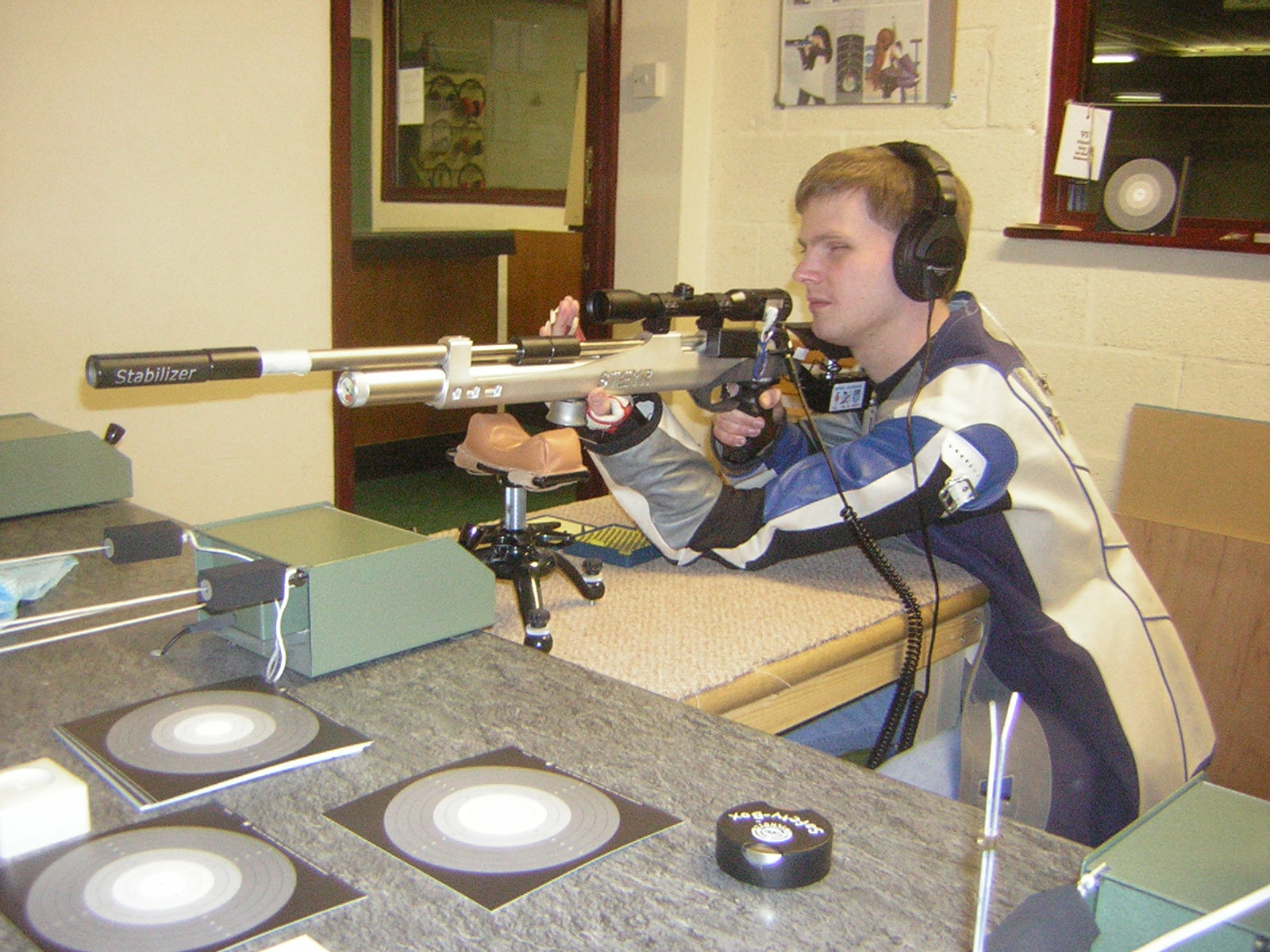
My feeling is that once one has got a reasonable position, then doing prone is quite comfortable and enjoyable. I have included a few photos showing me doing the prone last week, they may help you in understanding the position.

Experience of creating shooting videos

You may be aware that over the last few weeks I have been creating some videos for IBSA on vision impaired shooting. It has been quite an ex...